1. MongoDB JSON Documents
MongoDB = JSON Database
Best for
✔ REST APIs
✔ User Profiles
✔ Product Catalog
✔ Dynamic schema
2. DynamoDB :
Cloud NoSQL Database by AWS.
Stores Key-Value Document
DynamoDB = AWS MongoDB (managed service)
Advantages
Very fast
Fully managed
Auto scaling
Serverless
Shopping carts
Sessions
3. Redis :
In-memory database.
Redis = RAM Database
User Session
OTP
Cache
Leaderboard
Shopping Cart
Millions of operations/sec
Data Types
String,List,Set,Hash,Sorted Set,Bitmap,Streams, TTL
Best for
Cache, Session, Distributed Lock, Rate Limiter, Message Queue
Hadoop vs HDFS vs HBase
Hadoop
├── HDFS (Storage)
├── HBase (Database)
├── Hive
├── Spark
├── MapReduce
4. Hadoop
Hadoop = Entire Big Data Ecosystem
Purpose
Big Data Framework.
It is NOT a database.
It is NOT storage.
It is a platform.
Contains
HDFS, YARN, MapReduce, Hive, Pig, Spark, ZooKeeper,etc.
5. HDFS
HDFS means Hadoop Distributed File System
HDFS = Linux File System for Hadoop
Purpose: Distributed storage.
Stores : Huge files.
Example :
10 TB CSV
100 TB Images
1 PB Logs
Features
Replication
Fault tolerant
Distributed
Cheap storage
Not suitable for
Random lookup Transactions
6. HBase
Purpose
Distributed NoSQL Database.
HBase = Oracle built on HDFS
Built on HDFS.
Stores
Billions of rows.
Random read/write.
CustomerID
OrderID
TradeID
Unlike HDFS
HBase allows
SELECT WHERE ID=100
HDFS cannot.
7. Data Lake
Data Lake = Warehouse for all company data
Store ALL raw data.
Everything goes into Data Lake.
PDF,CSV,Excel,Image,Video,Logs,Database Dumps,JSON,XML
Common storage
HDFS
Amazon S3
Azure Data Lake
Google Cloud Storage
8. Spring Batch
Batch Processing. Runs once.
Spring Batch = Offline Processing
Processes millions of records.
Example Every night
Read 50 million trades
↓
Validate
↓
Transform
↓
Insert Oracle
↓
Generate Report
Not real time.
Usually scheduled.
Wait
↓
Process Tonight
↓
Finished
9. Event Streaming
Event Streaming = Real Time Processing
Purpose: Continuous data flow.
Unlike Batch Data comes Immediately.
Example: Credit Card
Everything happens instantly.
Receive Event
↓
Immediately Process
↓
Next Event
↓
Immediately Process
↓
Never Stops
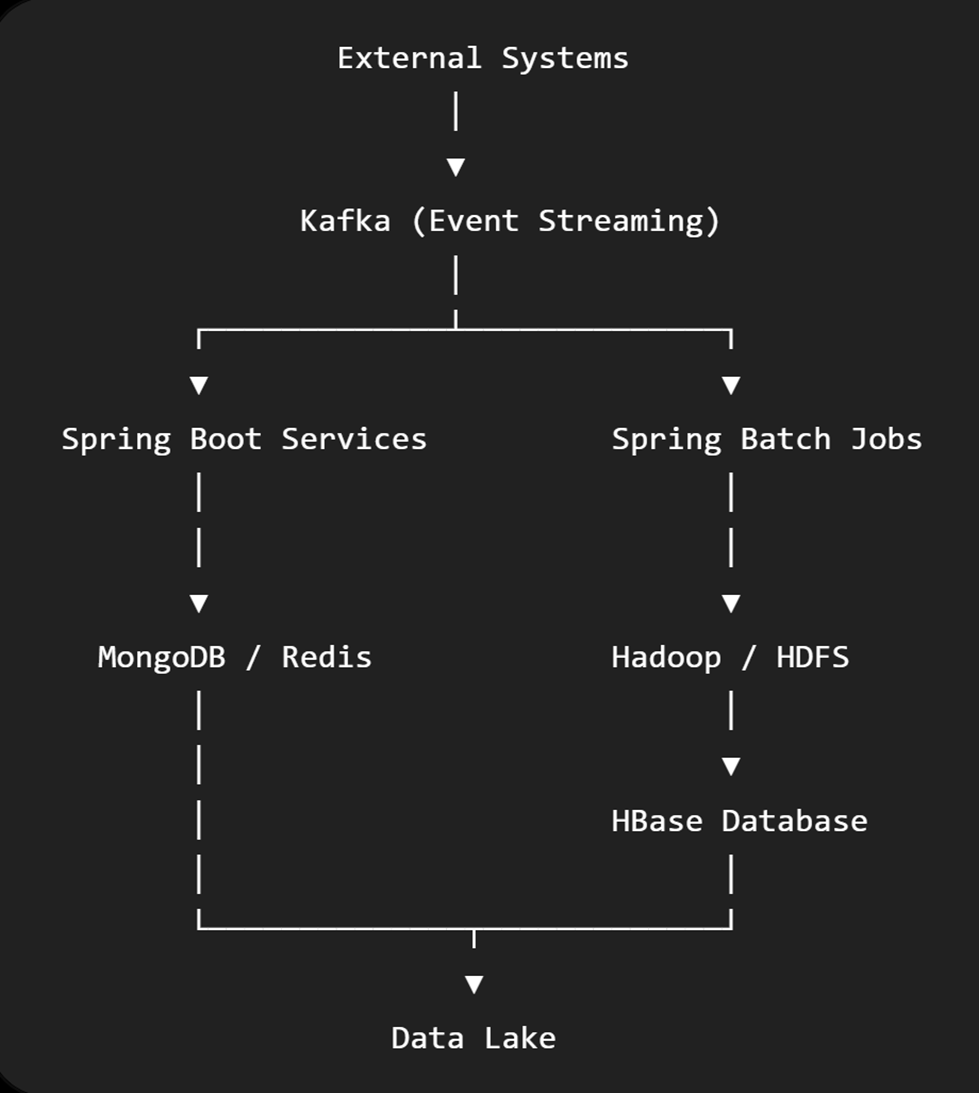
Big Data Flow
ATM
↓
Kafka
↓
Spring Boot
↓
Redis Cache
↓
MongoDB
↓
Spring Batch
↓
HDFS
↓
HBase
↓
Data Lake
↓
Analytics
How They Work Together (Real Banking Example)
Imagine Standard Chartered Bank processing credit card transactions:
1. A customer swipes a card.
2. The transaction is published to Kafka (event streaming).
3. A Spring Boot microservice validates the payment.
4. Frequently accessed customer data is retrieved from Redis for low latency.
5. Customer and transaction records are stored in MongoDB (or another operational database).
6. At the end of the day, Spring Batch processes millions of transactions for settlement and regulatory reporting.
7. Historical transaction files are archived in HDFS.
8. High-volume historical transaction records requiring fast lookups are stored in HBase.
9. All raw files, logs, reports, and exports are retained in the Data Lake for analytics, compliance, and machine learning.
This end-to-end flow is a common architecture in large banking and financial systems