Java Threads vs Virtual Threads | Why This Changes Everything
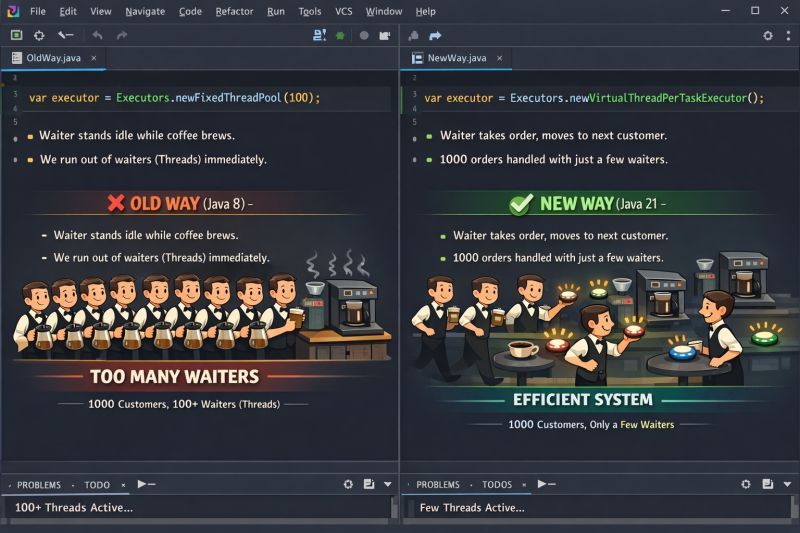
Imagine a Coffee Shop with 1,000 customers.
❌ The Old Way (Java 8 / Platform Threads)
The Model: "One Waiter per Customer."
You hire a dedicated waiter for every single customer.
1. Customer orders coffee.
2. The waiter walks to the machine and stands there for 5 minutes waiting for it to brew.
3. They can't help anyone else. They are "Blocked."
The Result: You need 1,000 waiters. You run out of money (Memory) and space (CPU). The shop crashes.
✅ The New Way (Java 21 / Virtual Threads)
The Model: "The Buzzer System."
You only have 5 Waiters (OS Threads).
1. Customer orders coffee.
2. The waiter gives them a buzzer, puts the order in, and immediately goes to help the next person.
3. When the coffee is ready, any free waiter picks it up and serves it.
The Result: You serve 1,000 customers with just 5 waiters. The shop runs smoothly.
👨💻 Back to Engineering:
In Java 8, a Thread maps 1:1 to an OS Thread (The Waiter). It is heavy (2MB RAM) and expensive.
In Java 21, a Virtual Thread is just a task (The Buzzer). It is cheap and disposable.
We used to write complex "Reactive Code" (WebFlux) to achieve this efficiency.
Now? You just change one line of code:
Executors.newVirtualThreadPerTaskExecutor()
The Takeaway:
Stop buying more servers to handle the load.
Just upgrade the JVM.