How we removed a synchronous dependency
in an e-commerce system
Imagine an e-commerce application with these services:
Order Service
Customer Service
Shipping Service
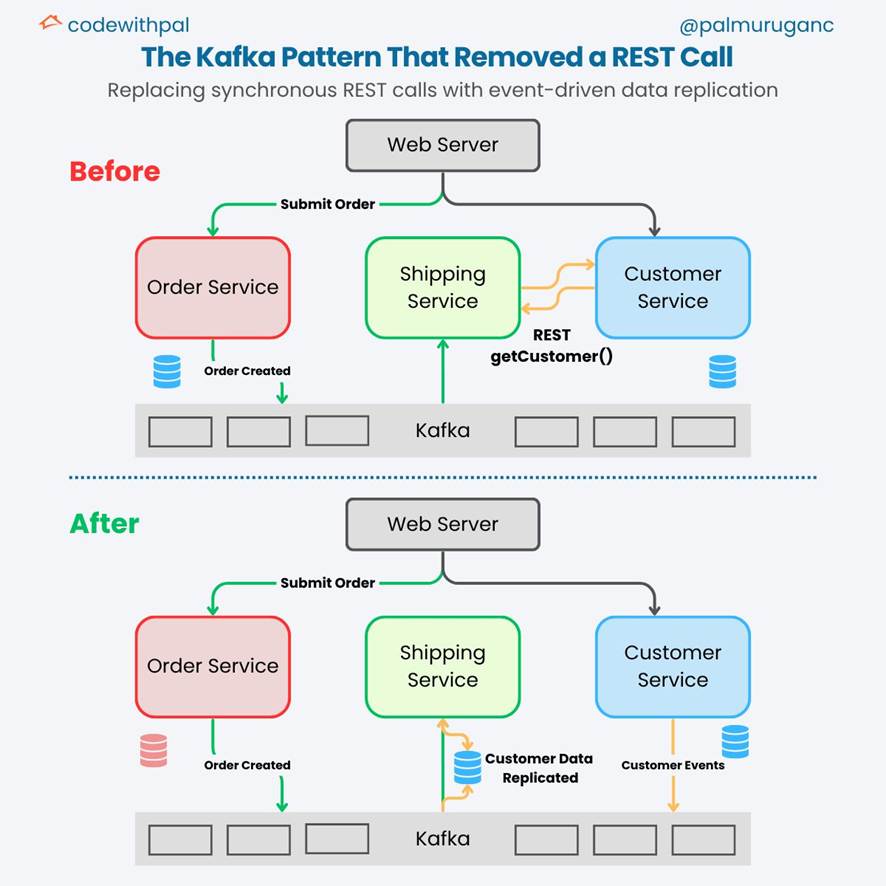
Initial Design
When an order is created:
Order Service publishes an OrderCreated event.
Shipping Service consumes the event.
Shipping Service needs the customer's address.
It makes a REST call to Customer Service.
Shipping Service --> REST --> Customer Service
This works, but creates a dependency:
Shipping cannot work if Customer Service is slow or unavailable.
Increased latency due to network calls.
More service-to-service coupling.
Improved Design: Event-Carried State Transfer
Instead of querying Customer Service every time:
Customer Service publishes customer updates as events.
Shipping Service maintains a local copy of customer data.
When OrderCreated arrives, Shipping Service already has the customer
information.
Customer Service --> Kafka --> Shipping Service
Now:
✅ No synchronous
REST call
✅ Lower latency
✅ Better
resilience
✅ Services are
more autonomous
✅ Fully
event-driven workflow
🥇 Key Lesson
Events are not only for notifications.
They can also be used to transfer state between services.
This pattern is called "Event-Carried State Transfer" and is commonly
used in large-scale microservice architectures to reduce service coupling and
improve reliability.
Have you used local data replication instead of service-to-service REST calls
in your microservices?